SpaceX Odyssey
Quarterly review
Quarterly review


Richard Morin

Asmaa Saleem Malik
The balanced portfolio—60% stocks and 40% bonds—is up 8.7% for the quarter and 9.2% year-to-date. An excellent result.
One might have thought that Trump’s war against Iran would be the dominant event in the stock markets during the second quarter. After all, this war made headlines almost daily in the weeks leading up to the ceasefire on June 14, 2026, and it has continued ever since. Predictions were that the price of a barrel of oil would reach $200 and that the impact on the global economy would be devastating.
However, that is not the case. Oil prices have returned to their pre-conflit levels, and the global economy is doing quite well.
As for the stock markets, they are near their record highs. The U.S. stock market is up 17% for the quarter and 15% year-to-date. Weighed down by oil prices, the Canadian stock market is up “only” 7% for the quarter and 11% year-to-date. As we mentioned in our last issue, wars generally do not have a lasting impact on the markets—whether driving them up or down. We must therefore look elsewhere for an explanation of the excellent returns since the beginning of the year.
On June 12, 2026, SpaceX completed the largest initial public offering (IPO) in stock market history. The company raised a total of $75 billion, and its market capitalization at the time of listing was $1.77 trillion (1,770 billion). By way of comparison, at the time of their IPOs, Google (2006) and Facebook (2012) had market capitalizations of $23 billion and $104 billion, respectively.
SpaceX is the first of a trio of mega-cap companies in the artificial intelligence sector expected to go public this year—the other two being Anthropic and OpenAI. These IPOs come amid hundreds of billions being invested to develop artificial intelligence and the infrastructure needed to support it. This sector is driving the resurgence of the U.S. stock market and other stock markets in the second quarter.
Until it becomes clear whether all this investment in AI will generate profits, stock market returns will remain heavily dependent on this sector. If it fails to do so, a major market correction will likely follow.
It is against this backdrop that some have voiced concerns regarding the weighting within stock indices of a loss-making company like SpaceX, which is trading at roughly 100 times its revenue (revenue, not profit!). For the moment, these fears are unfounded; despite a market capitalization approaching $2 trillion, what matters is the value of shares available to the public—specifically, the $75 billion issued during the IPO. Consequently, SpaceX’s initial weighting in major indices is currently less than 0.15%. Only in the coming months, when currently escrowed shares are released, will SpaceX’s weighting in the indices rise to approximately 1.5% (assuming the share price remains constant). It’s significant, but still much less than stocks like Nvidia, Apple, or Microsoft.

In any case, if AI falls short, the entire industry will suffer—not just SpaceX. Stay tuned!
The Canadian stock market rose 7.0% in the second quarter of 2026, bringing the year-to-date gain to 11.2%.
The financial sector, which accounts for 36.2% of the S&P/TSX Composite Index, stood out in the second quarter of 2026 with a 24.7% gain. RBC posted strong performance in its wealth management and capital markets segments, along with robust earnings growth, while TD benefited from strong results in its Canadian retail banking business and an increase in net interest margin. BMO posted strong results in its wealth management and capital markets businesses, and Scotiabank’s results were supported by improved margins and stable credit risk. Overall, the sector was driven by earnings resilience and continued capital distributions to shareholders.
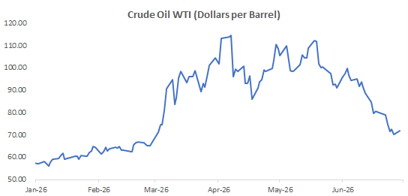
The energy sector fell 5.8% amid declining oil prices, while signs of progress in negotiations between the United States and Iran bolstered expectations of a potential peace agreement. Investors anticipated that an easing of tensions could facilitate the reopening of strategic shipping lanes, notably the Strait of Hormuz, and allow additional volumes of Iranian oil to reach the global market. As fears of supply shortages subsided, crude oil prices retreated from their previous highs.
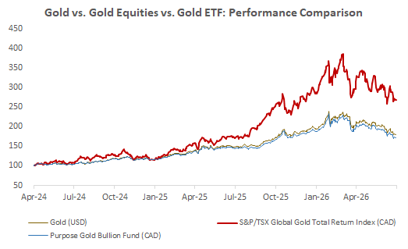
The price of gold fell 16.1% in the second quarter of 2026, as rising U.S. Treasury yields and a stronger U.S. dollar reduced investor demand for the precious metal. In relative terms, gold mining stocks (S&P/TSX Global Gold Index) outperformed physical gold and gold ETFs, supported by the sensitivity of these companies’ earnings to the price of gold.
U.S. stocks rose 17.3% in the second quarter of 2026, despite a more challenging market environment.
The U.S. market fluctuated between optimism driven by corporate earnings and AI-fueled growth on the one hand, and concerns about persistent inflation, high yields, and geopolitical risks in the Middle East on the other.
The information technology sector, which accounts for approximately 38.0% of the S&P 500 Index, was one of the top performers in the second quarter of 2026, posting a gain of 31.6%. Investor enthusiasm for artificial intelligence (AI) continued to drive strong demand for companies well-positioned to capitalize on investments in AI infrastructure.
While several major technology companies contributed to the sector’s performance, companies specializing in AI infrastructure—notably semiconductor and memory leaders such as Advanced Micro Devices (AMD) and Micron Technology (MU)—generated particularly high returns, outperforming many of their peers in the technology sector. The chart below highlights the strong performance of these two AI infrastructure leaders, which stood out among tech stocks during the second quarter of 2026.

International stocks rose 12.6% (in Canadian dollars) in the second quarter of 2026.
Japanese stocks rose 15.7% this quarter. The market’s performance was driven by companies in the semiconductor sector, as strong demand for cutting-edge chips benefited Japanese equipment manufacturers. SoftBank, a major beneficiary of the investment cycle fueled by artificial intelligence, surpassed Toyota to become Japan’s largest company by market capitalization.
European stocks also rose in the second quarter. Technology stocks performed well, buoyed by growing demand for semiconductors and data centers. ASML, the Dutch chip equipment manufacturer, was among the companies that benefited from the boom in artificial intelligence.
Emerging markets rose 24.7% (in Canadian dollars) in the second quarter of 2026, bringing the year-to-date gain to 26.7%.
South Korean stocks surged 79.3% during the quarter, bringing their year-to-date performance to 111.7% and propelling the market among the world’s top-performing major indices. This rally was driven primarily by a few tech heavyweights, notably SK Hynix and Samsung Electronics, as earnings momentum fueled by artificial intelligence continued to dominate the region’s stock market news.
Taiwanese stocks rose 50.6% in the second quarter, bringing the year-to-date return to 67.5%. The market’s performance was driven by Taiwan Semiconductor Manufacturing Co. (TSMC) and supported by the continued surge in demand for artificial intelligence and semiconductors.
Indian stocks rose 14.6% in the second quarter, buoyed by resilient domestic demand and investors' continued confidence in the country's long-term growth prospects.
Chinese stocks fell 5.3%, as expectations for more aggressive stimulus measures largely failed to materialize.
During the second quarter of 2026, the yield on 10-year Government of Canada bonds fell from 3.46% to 3.38%; this decline led to a slight increase in bond prices, enabling Canadian bonds to generate a total return of 2.0% for the quarter and bringing the year-to-date return to 2.2%.
In June, the Bank of Canada kept its key interest rate unchanged at 2.25%, adopting a cautious, wait-and-see approach to evolving inflation and growth trends.
The yield on 10-year U.S. Treasury bonds rose from 4.30% to 4.44% amid geopolitical uncertainty, rising energy prices, and persistent concerns about inflation.
